Archive Post
How does SD-WAN support video conferencing requirements in times of delay and jitters on VOIP platform?

Video quality can suffer if the network can’t meet its high bandwidth needs. Video conferencing can take on many forms and protocols. For enterprises that have experienced problems, such as delay and jitter on voice over IP platforms, you know some platforms are better than others. The big variance in supporting video conferencing requirements is the integrity of traffic over wide-area connections.
Software-defined WAN (SD-WAN) technology removes the need for physical connections from point A to point B by using logical connections or tunnels. But the biggest advantage is SD-WAN is link-agnostic. It doesn’t care if the line is Long Term Evolution, OCx or DSL; the software still manages the links. These lower-cost circuits can provide significant savings for small or remote offices when compared with more expensive MPLS circuits.
With increased video traffic, transmission problems can only get worse. For proper support of video conferencing requirements, you want to prioritize traffic or provide better links to improve service. Data, such as file transfer, can handle some retransmissions. But, with voice and video, dropped packets create gaps that materialize in the form of missing words and pixelated video.
If a company is not using dedicated MPLS for voice and video, it will need some way to assign a higher priority to voice and video, or provide a better circuit to mitigate dropped packets. SD-WAN is one such service for video conferencing support, as it can measure round-trip time, jitter and packet loss to map the best path based on the application’s type, such as real time.
A nice feature of SD-WAN is the ability to bond internet connections — regardless of type — to create higher-speed tunnels that function like point-to-point links with bandwidth that is faster than any single link in native form.
Another advantage is devices are placed at remote sites, but centrally managed. This allows for ready reconfiguration without having to attach to each device. But because some quality-of-service functions don’t exist in SD-WAN, it can’t actually guarantee QoS. But making the links robust and mapping best paths can help with some of the issues you would find without SD-WAN.
SD-WAN can support video conferencing requirements with various optimization techniques, such as deduplication, caching and buffering. In several ways, you can figure out some VoIP and video functions without jumping to an MPLS link, which translates to big savings. Some vendors put the savings at around 70%, but it will vary from company to company.
Source:techtarget.com
Projectors are becoming one of the fastest growing product lines in India
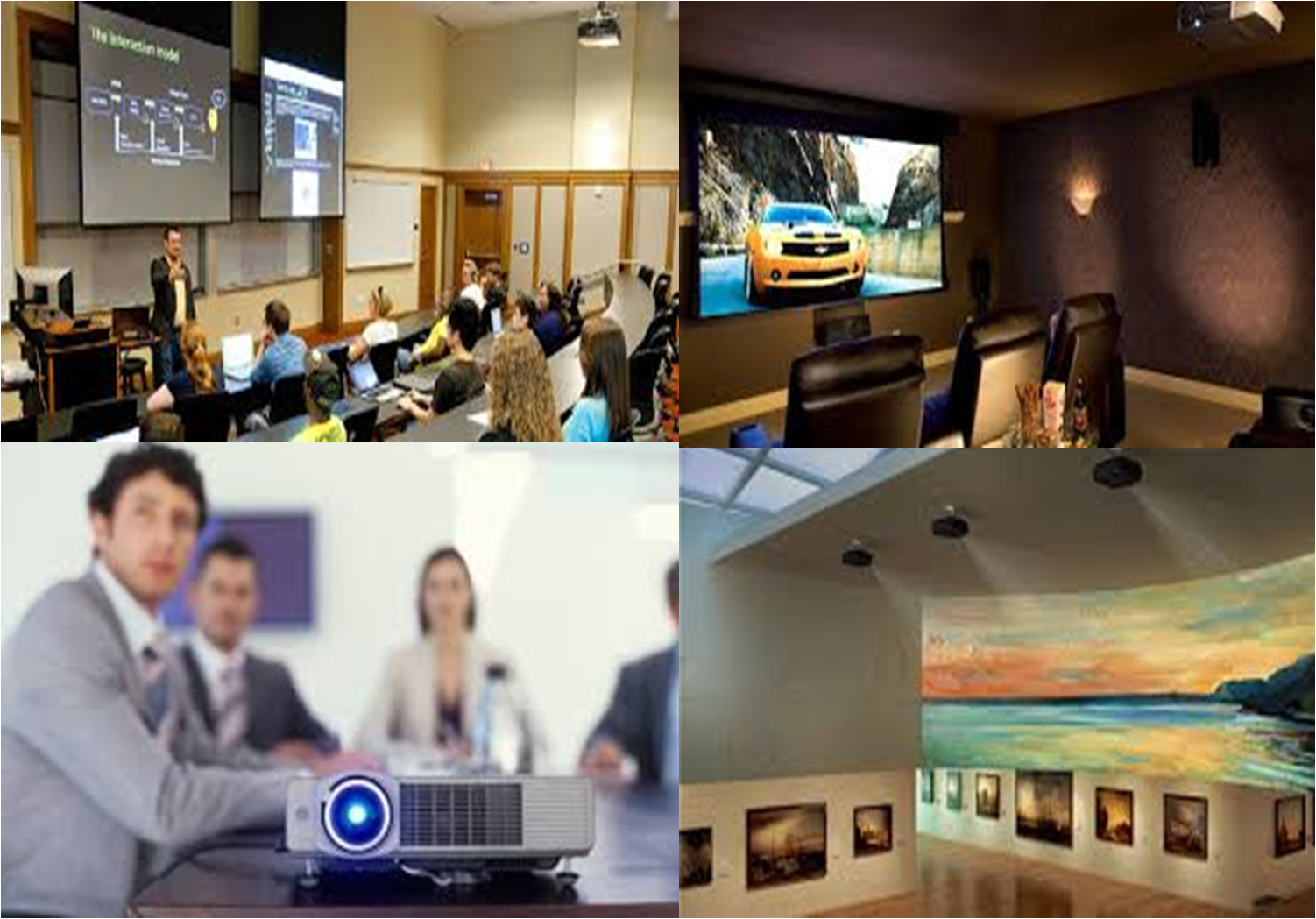
Projectors are one of the fastest growing product lines in India due to the booming education market. Changing lifestyles, decrease in price and rising spending on electronics has led to an upsurge in demand for high-end products including projectors. Various emerging segments such as Education and Audio Video System Integration in commercial segment are booming with demand for projectors. India’s education sector is moving towards the digital age. Educational system integrators are thriving in India and helping to cater to the growing requirement of audio-visual equipment
According to “India Projector Market Outlook, 2019”, India’s projector market was growing with a CAGR of 21.74% by volume over past four years. IT, corporate, media, entertainment, rental, BPO and education sectors were the major industries driving the sales of projectors. The education sector is reportedly the biggest segment of digital projector sales in 2014 followed by mid-size and small business segments. Beyond this, development in the home entertainment and gaming segment is also being scaled up with the arrival of 3D, HD and Wi-Fi support features within current projector models. These days the projection technology is more sought after in homes with spectacular increase in availability of full HD and 3D content in form and availability by HD DTH and Blu Ray discs.
Businesses are looking for office projectors that are optimized for presentation use in conference rooms, boardrooms, and lecture halls. The business projectors category includes the latest technology in DLP, LCD, LCoS projectors. The category includes projectors from lightweight portables to projectors with 10,000+ lumens. Education projectors include standard portable and fixed installation projectors, also short throw and interactive projectors. If a big screen TV isn’t exciting enough, home theater projectors can give a whole new meaning to movies, television programs, or games. Projectors replace the ordinary TV with a much larger screen, flexibility to be moved around, and high-quality images. Originally, these systems were only available for commercial entertainment or business uses, but now it is becoming more affordable for the average household, making it possible for everyone to enjoy a true cinema experience in the comfort of their own home. In addition, the cost per image area with a projector is actually much lower than the cost of a traditional TV. Companies, such as Epson, Acer, and Viewsonic, manufacture multimedia projector systems that can be used to create a full HD home theatre.
The technology used in projectors can generally be broken down into two types: DLP and LCD. DLP (Digital Light Processing) projectors use mirrors to project their images. They shine the light onto a chip with microscopic mirrors called the digital micro mirror device. Each mirror is one pixel of the projected image. That light is then reflected off of the mirrors and through the projector lens. The DLP is the most affordable type and still delivers high quality images. LCD projectors pass light through three LCD panels that are red, blue, or green. During this time, the pixels can either allow light through or be closed off. The combination of open and closed pixels produces a wide range of colors projected as the moving image. LCD is the major technology used in modern projectors. Because of the advanced technology they use, LCDs are more expensive than the DLPs.
Both the technologies LCD and DLP have an almost equal market share in 2014 with DLP technology slightly ahead. However, in future the trend is expected to reverse with LCD technology to dominate the market heavily. Moreover, the market will continue its shift towards new technologies like Lazor Interactive/LED Interactive Android due to the low maintenance cost and superior technology. High-Definition (HD) projectors are replacing the Standard-Definition (SD) projectors due to increasing popularity among consumers.
Out of the total shipment, almost one-third market is captured by 1024×768 display resolutions, followed by 800×800 resolutions. Higher resolution projectors are less likely to require signal compression and its associated loss in quality. Hence, High-Definition will be the most popular display resolution in future with highest market share by 2019. In this crowded market, BenQ is the No. 1 brand in India followed by Epson, InFocus, Hitachi, Panasonic and many others. The metro markets dominate the consumption but new demand is expected from tier II and tier III cities with rapid urbanization of these towns. The vendors are targeting more than 30 Indian towns beyond the top eight metropolitan centers for projectors.