Archive Post
Wi-Fi hotspots at more than 4000 semi-urban and rural stations

RailTel and the Department of Telecommunications (DoT) are planning to deploy Wi-Fi hotspots at about 4,000 semi-urban and rural railway stations across the country. The proposed initiative, which is expected to entail an investment of Rs 4 billion, will give boost to the government’s Digital India programme and a deeper penetration into rural India which haven’t been covered by telecom infrastructure. RailTel is seeking DoT’s approval to fund this program through a USO (Universal Service Obligation) fund. The corpus was created in 2003 to support projects for communications and technology access to people in rural and remote areas at affordable prices. The initiative can help bring connectivity to the rural areas as hotspots can serve an area of 8-10 kilometers. . Infrastructure at wayside railway stations can be utilized and it can host functions of a common service center (CSC).
Indian Railways’ telecom infrastructure provider covers 70% of the India’s population through optic fibre cable (OFC) network, connecting country’s major semi-urban and rural regions. Introduction of WiFi connectivity in rural areas will open avenues for other services such as banking, education, healthcare and employment. Government support is vital for this initiative and consideration should be given to operating expenditure subsidy.
It is expected that Wi-Fi network will be rolled out ‘very fast’ as the wayside railways stations already have a required bandwidth and are equipped with basic infrastructure such as power availability, and the spare space at premises that can be turned into Internet-driven kiosk akin to CSCs. In order to make this viable a village panchayat or block-based model can be created for services offered using neighborhood’s railway station infrastructure. RailTel is also working with US Internet major Google to deploy Wi-Fi hotspots at large railway stations and is expected to roll out network at 100 railway stations by this year end and 400 by 2018. The Indian Railways business currently constitutes a mere 10% of the RailTel’s overall revenue while the PSU also manages the business from telcos (20%), government (30%) and enterprise (25%).
Google and Levi’s partner together to create ‘Smart Jacket’

Smart jacket in town? Google and Levi’s Denim have entered into a partnership to develop a smart jacket using a technology codenamed Project Jacquard that lets users interact with their Smartphones by swiping at the garment in various ways. Jacket, also known as ‘Computer Trucker Jacket’ is designed mainly for cyclists who can control their phones safely while riding.
Google’s Advanced Technology and Projects (ATAP) division partnered with Levi to utilize its Project Jacquard technology, announced last year, centered around connected textiles and clothing. The tech, which is basically composed of conductive fabric woven into the garment to create an interactive patch that senses touch, pressure and even your hand’s position before you touch the fabric. Jacket contain a weave of the Jacquard interactive threading on the left arm and a Bluetooth-enabled loop to connect to the cuff of the jacket. That cuff lets your phone talk to the jacket, and you can configure exactly what gesture you want to work with which apps. For example, you can adjust the volume on your music, tap to change the track or even use gestures to get navigation directions from Google maps. Currently Jacquard is restricted to only calls, messaging apps, Google Play music, Maps and third party apps from Spotify and Strava. The Project Jacquard garment will be available in spring 2017 and not much is known about the cost of the garment.
The Jacket is manufactured pertaining to the Levi’s standard manufacturing techniques and doesn’t need any special care. Only the Bluetooth cuff needs to be removed before washing it. Google wants to develop more apps and technology and enter athletic clothing as it would be more appealing and cater large audience.
Latest announcements from Google’s I/O 2016 will surely blow your mind

Google announced welcoming news on its latest I/O. To start with VR(Virtual Reality) , there have been 50 Million downloads of its virtual reality apps for the Cardboard platform from the Play Store. This is an important step for virtual reality on mobile, and more importantly, it shows developers that there is demand for this sort of thing. In its latest conference it has announced that it will delve deeper into the realm of virtual reality with a system called Daydream which will be available to users end of the year. Google will sell this virtual-reality headset with a wireless motion controller with the Nexus brand that the company original created as a showcase for its Android operating system for smartphones.
Google wants to change how people manage their daily lives. So it will introduce a personable form of artificial intelligence into an Internet-connected device called Home. Google touted its Home speaker as a more intelligent and versatile device, mostly because it can tap into the same stockpile of information that makes Google’s Internet search place so popular. Google also has redesigned its virtual assistant to be more conversational and intuitive. It will be the voice and brains inside Google Home. Home even integrates with third-party services, allowing you to do things like call an Uber car or book a restaurant reservation using OpenTable.
One of the biggest announcements that Google made was a feature called Instant Apps. It will have the ability to run on device without even installing them. Instant Apps is Google’s answer to the pain of installing phone apps you know you’ll use just once or twice, for shopping or booking a parking spot, for example. With this approach, the app runs on Google’s servers instead of your phone. Only the parts you need are sent to your phone on an as-needed basis.
Google search changed the world, literally. Now, Google Assistant is the natural extension of search, supporting “conversational understanding” to make search more natural and to better support voice searches. It has also announced a chat service called Allo. It will draw a vast database to predict how a user might want to respond to a text and automatically fetch links to video clips and other relevant information to an ongoing conversation. Duo will be Google’s companion app for Allo that adds in video calling. For example, Knock Knock lets users see the incoming video call feed before even answering the call. This way, the receiving party can see whose calling and where they are before they even pick up the call.
Google’s next major mobile software release is Android N, and it’s going to be a huge update when it’s released later this year. Performance and graphics improvements are a big part of Android N. Most impressively perhaps, Android N will download and install system updates automatically. Moving on to the app switcher screen, Android will automatically remove apps from the UI when it determines the app is no longer needed. This way, the app switcher UI is decluttered and it’s easier to find the app you’re looking for. There’s also a new quick switch function accessed by double-tapping the recent button on a phone or tablet. Although the upcoming products will offer some unique features, they mostly painted a picture of a company scrambling to catch up with its rivals.
Penalty on Telecom companies relaxed as court rules out TRAI’s directive for call drop
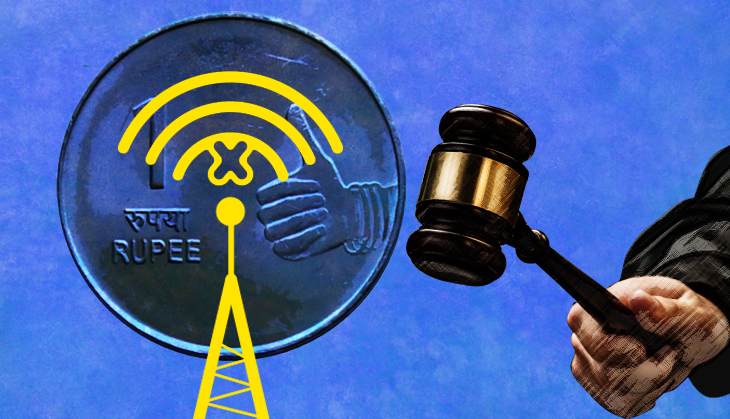
What are these issues regarding call drop? Supreme Court struck down the TRAI’s (Telecom Regulatory Authority of India) directive imposing for call drops on telecom operators. Major issue is that a lot of subscribers belong to low income group (wage earners) who recharge for Rs 10 to Rs 20 coupons. A call drop is a pinch in their pockets and eventually they are left with no option but to make another call. This again adds to their misery. To combat such a situation telecom regulator TRAI had proposed to penalize telecom companies at Rs 1 per call drop up to a maximum of three calls a day, to be credited to the calling customers account. It is this infirmity that led to strike down the order as ambiguous.
The Court pointed out that call drops cannot exceed two percent of the calls. The majority of service providers claimed it to be under two percent. TRAI has failed to look into other factors behind the call drop such as paucity of spectrum, radio interference from neighbouring cells, shortage of mobile towers, and problems of clearance from agencies. Faulty handsets and manipulation by consumers add to the call drop issue as well.
The call drop problem is real. Consumers are charged for the full time even when the call breaks in the first few seconds. Operators make gains from this. The court has said that Parliament can enact a call drop compensation rule without detracting from the regulatory powers of the TRAI. TRAI needs to grant more spectrum and mobile phone towers to the telecom companies. A lot of issues might arise, such as resistance from locals to installing of tower and clearance from local authorities. These needs consideration and good consultation. It is time that telecom companies take responsibility for any deficiency of service because the consumer wants a solution and not compensation.
‘112’ will be India’s all-in-one emergency number from January 1, 2017.
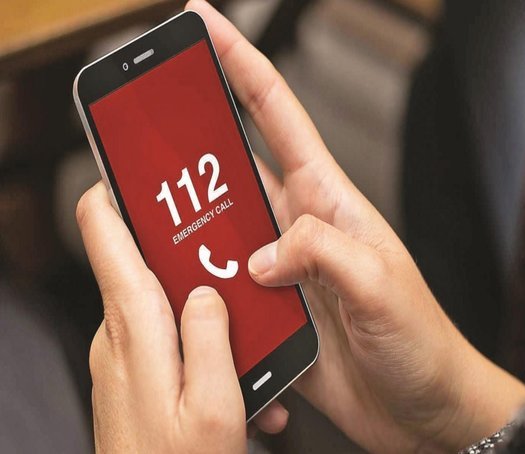
Indians will now be a call away from any kind of distress situation. The single number provision would be similar to the ‘911’ all-in-one emergency service in the US. Users having SIMs and landline whose outgoing facility are abandoned or temporary suspended, can also avail the service by dialing 112. Calls will be diverted to the concerned department without any extra waiting time. User will make communication through SMSs, or call and the system will learn about the location of the caller. This will then be shared with the nearest help centre. People will be able to feed ‘112’ in panic button system which will also be available on all mobile phones from January 1 under the law. It will enable users to make emergency call or send alerts to multiple numbers just by pressing a button.
Currently India has different communication and response system such as police (100), fire brigade (101), ambulance (102) and Emergency Disaster Management (108). All existing emergency numbers will be phased out within a year of rolling out 112, depending upon the awareness about this new facility. An inbuilt GPS navigation system would be mandatory for all phones a year later with effect from January 1, 2018. The emergency service calls will also be supported through a call centre like facility, which will have representatives speaking in Hindi, English and the local language. The existing call centres which handle emergency number calls will be asked to handle calls on 112 as well. And additional capacity is being worked out by the department.
NDA Government on a mission to deploy mobile connectivity to more than 55000 villages by 2019

Increasing demand for mobile has led the NDA government to deploy it to small towns and villages across the country. The Government plans to phase out broadband connection in more than 55,669 villages by March 2019. The move, by the department of telecommunication, includes the project to connect over 8,600 villages in the north-eastern region of the country. Villages will be connected by installing 321 mobile tower sites by September 2017. The Project has been approved at an estimated cost of Rs 5336.18 crore.
Telecom has confirmed installing of the optic fibres in 48199 gram Panchayats. For deeper digital penetration in rural areas, the government has taken up the BharatNet project in mission mode to connect all 2.50 lakh gram Panchayats, which have over 600 million people. It will support e-governance services, e-commerce, tele-medicine, tele-education, financial services, among others. Connectivity in areas affected by left wing extremism (LWE), a total of 1517 towers out of 2199 identified by Ministry of Home Affairs have started functioning till date. Penetration in rural areas will open windows to mobile operators and cable TV operators to launch next generation services and create employment opportunities for the locals.
Technology turns Arm into a Touchpad to control Smartwatch

A new technology developed at Carnegie Mellon University by the Human-Computer Interaction Institute’s Future Interfaces Group, enables users to turn their entire lower arm into a touchpad for controlling Smartwatches. This technology, called the SkinTrack allows continuous tracking on the hands and arms. It can detect touches at discrete locations on the skin, enabling functionality similar to buttons. The user wears only a signal- emitting ring which propagates an electromagnetic wave in the skin that can be localized with sensors worn on the wrist.
The biggest advantage of SkinTrack is that it is not obstructive. It provides a larger interface for the users compared to the Smartwatches and digital jewellery where the interaction area is small because most of the area is covered with finger. By using electrodes integrated into the watch’s strap, it’s possible to pinpoint the source of those electromagnetic waves because the phase of the waves will vary. Electrodes corresponding to the 12 o’clock and 6 o’clock positions on the watch, for instance, can detect phase differences that can determine the position of the finger along the width of the arm; electrodes at the 3 o’clock and 9 o’clock positions can determine the finger’s position along the length of the arm.
SkinTrack technology has various other functions such as a game controller, to scroll through lists on the Smartwatch, to zoom in and out of onscreen maps and to draw. A number pad application enabled users to use the back of the hand as a dial pad, hovering a finger over the hand as a cursor, highlighting numbers on the screen to aid in targeting touch points.
So far this wearable technology is safe. The radio frequency signal does not have an impact on the health of the user. Human body is accustomed to using daily appliances right from current drawn from the finger by touch screen to the electromagnetic noise from florescent lights with no ill effects.
India gets its own GPS with IRNSS-1G Satellite launch
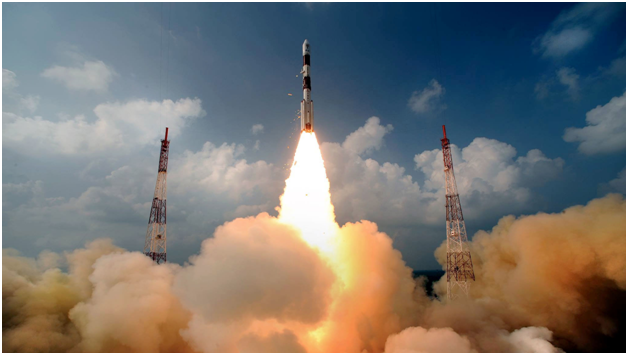
India is not far behind the developed nations. The country is on a mission to get its own version of Global Positioning System (GPS). An Indian Polar Satellite Launch Vehicle (PSLV) rocket lifted off successfully with the country’s seventh satellite, IRNSS-1G (India Navigation Satellite System) from the Satish Dhawan Space Centre in Sriharikota near Chennai on April 29. It consists of a constellation of seven satellites of which six – IRNSS-1A, IRNSS-1B, IRNSS-1C, IRNSS-1D, IRNSS-1E and IRNSS-1F- have already been put into orbit. It is like a position information portal of the entire country and covers around 1500km around the Indian mainland (boundaries). It stands tall at 44.4 meters and weighs around 320 tonnes. The rocket would put IRNSS-1G into orbit at an altitude 497.8 km. It has a life span of 12 years.
ISRO (Indian Space Research Organisation) has set up a ground facility across 18 different locations which will be responsible for satellite ranging and monitoring, generation and transmission of navigation parameters, etc. Users will have a position accuracy of better than 20 meters. The IRNSS will offer two types of services namely Standard Positioning Services for all users and Restricted Services (RS) which will be provided only to the authorized users. The restricted service will be used by the military for missile delivery and navigation and tracking of aircraft. Other applications of IRNSS include aerial and marine navigation, disaster management, vehicle tracking and fleet management, Search and Rescue (SAR) operations, Mining and Surveying and other Mapping operations. With the constellation of satellites complete, India has joined the league of countries that has an indigenous navigation system. Thus marks the beginning of a developed nation, reducing dependency on the US Global Positioning System.
Work offer App for Medium businesses by Google!
So far Google has been very successful in capturing the consumer market because it was in tandem with consumer needs. Whilst Google offers a suite of corporate applications and services, certain products have not made an impact in the corporate market. For example Chromebook has been a great success for the education market but has yet to make much of an impact on the corporate side of things.
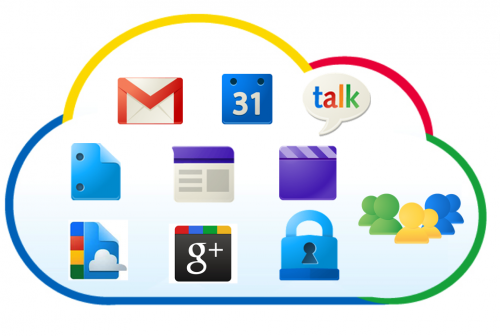
Google has launched a new Google Apps service free for the remainder of the Enterprise Agreement plus support for training needs. Basically, Google Apps is a package of cloud-based services that can provide your company or school with a whole new way to work together online—not just using email and chat, but over video conferences, social media, real-time document collaborations, and more. The app will give control over your user’s data and security.
Companies that qualify will obtain a voucher for specialist security training as a part of the migration to the Google way of working. Some companies are easing the process of migration by offering services such as safety of accounts from hijacking using encryption and a two step verification. Google is keen to highlight that companies with basic agreement have potential to cut costs by 70 percent. It is a productivity suite for your business that helps you get work done from anywhere on any device. A worker with an Android Smartphone and Google Chromebook could have full access to the Google Apps for Work suite at a very inexpensive cost of hardware. And of course, switching companies to the Apps at Work plan utilizes Google’s existing cloud infrastructure.
‘Panic Button’ will now ensure a safe nation for women!
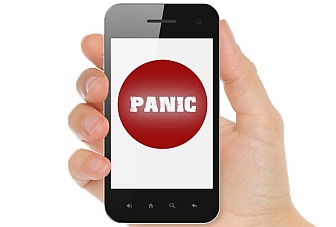
Women will now have an option to signal a family member or police authorities in distress situation by pressing a panic button in their respective mobile handsets. The Ministry of Women and Child Development had taken up the issue of installation of a physical panic button on mobile phones as one of the initiatives in June 2014.The Department of Telecommunications has notified the “Panic Button and Global positioning Systems in Mobile Phones Handsets Rules 2016″. Under these rules, effective from January 2017, all feature phones will have the facility of panic button configured to the numeric key 5 or 9 and all smart phones will have the panic button configured to three times short pressing of the on-off button. Further, from January 2018 all mobile phones will be required to have the facility of identifying the location through satellite based GPS.
The minister of Women and Child Development will now be working with DOT and other stakeholders to ensure that similar solutions be made available for existing handsets in the form of software patches. These software patches will be available for direct download in Smartphones and an installation at the mobile phone shops by concerned manufacturers/service provider. Reports of attacks on women in India have reverberated around the world, increasing pressure on officials to make the country a safer place. Technology will make human life better and what better than using it for the security of women.